
THE WORLDS FINEST SHIP, ALSO KNOWN AS HOME
General description
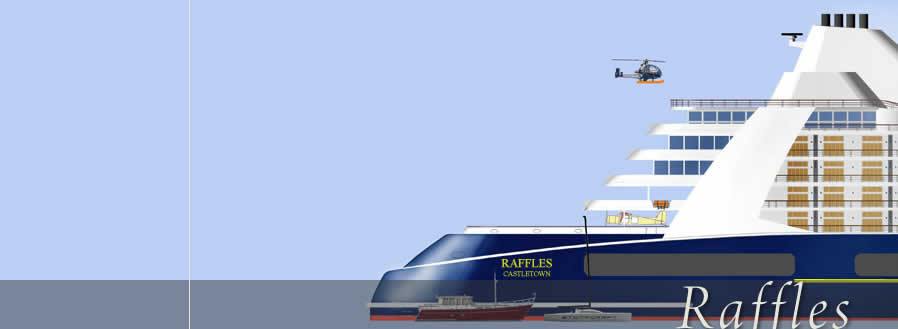
Raffles is a mono or single hull vessel similar in many ways in its above water outward appearance to a cruise ship, but much smaller than most, modern cruise only vessels, and without the ugly box stern superstructure that is common in today’s cruise and residence vessels.
With only 4 decks in the hull and 4.5 in the superstructure it is relatively low profile and thanks to its about 239m overall length, at least looks to be “fast”.
It is however purposely designed to operate most economically at about 8 knots, keeping its 14 to 16 knots maximum speed in reserve, for emergency use only.
The hull is steel and superstructures are all aluminium with the division occurring at the 6m high main (bulkhead) deck level, on and above which are located all the main public spaces and above again, 122 spacious apartments. The lowest apartment is thus about 10 meters above the waterline (in most modern cruise ships crew accommodation is buried at the bottom of the ship).
Also at the main deck two open boat decks are positioned one on each side, both with 2 x 150 passenger mono hull enclosed lifeboats that unusually for a passenger vessel are never used as ferries, thanks to the fact that Raffles carries its own high speed ferries and water taxis in its marina.
Not using the lifeboats as ferries with such use typical of all cruise ships also means that they will last at least as long as Raffles.
The fore deck or “focsle” is unusual for such a vessel in that it is totally flush, a “whale back” (North Sea trawler style), designed to shed waves quickly without damage when operating in areas such as the route from New Zealand to Antarctica, about the only rough water Raffles will ever purposely enter.
At aft is a large open deck with sheltered hanger/garage forward, with the four decks of superstructure stepping down to it from the stack. This deck is used for storage of larger boats including a carbon composite, 38’ sailboat, 6 person float plane, 3 person submarine, 2 man helicopter and various vehicles that can be unloaded with its own 100 tons extending boom crane. It also houses the 436 survivor marine evacuation system (MES).
The aft deck area is also a separate “safe area” that SOLAS is anticipated to demand in the future.
Below the open deck in the aft part of the hull is a totally unique feature not found on any other passenger ship: a vast 48m long about 1,900m3, two level, drive-in 450m2 wet surface area dock / marina that at nearly 4 stories high can easily accommodate the two 15m expedition / dive boats, 12m landing craft and 16m high speed ferry that Raffles carries. It is also a recreation centre with diving store and equipment for 12 air divers, plus a multitude of water “toys” stowed here.
The about 369 meters length (12,000m2) of open, A/A1 decks, along the top of the superstructure are reserved for relaxing, centred around the 25m long 3m deep pool at midships, or in the two restaurants (one at forward formal at aft casual) the 200m2 (2,000ft2) gym / sauna and the children’s play room / area.
A single funnel or “stack” is positioned at centre near the aft end of the upper decks with the raised deck below / behind it also used for helicopter operations allowing both landings and take offs into the wind.
All of the main air conditioned public spaces formal lounge, reception, supermarket, hospital, auditorium, etc. about 5,000m2, are located at the 6m high main deck level immediately below the apartments. Minor facilities such as the post office, business centre, bank and place of worship are located in the superstructure at various deck levels mainly in the 5m wide central core between apartments.
The hull is divided by full depth / width transverse WT bulkheads and cofferdams into 16 main transverse sections and with 5 almost full length, longitudinal WT bulkheads. Horizontally there are 3 deck levels, including the tank top, over the 2m high double bottom. In place of WT bulkheads Raffles has 2m wide full width / height cofferdams in 6 locations including two (2) full strength collision bulkheads forward.
Many of the about four hundred (400) WT hull spaces are empty / unused and the largest compartments are the two main machinery spaces or “power stations” both 6m (two decks) high and 30m long x 11.75m wide between 2m wing tanks outboard and one deck above the tank top. The control room and below it the main switch / power conversion room are WT / fire proof 5m wide, located between the two machinery spaces.
Fuel, lubricant and cooling water treatment systems and storage are isolated in the 3m high spaces immediately below each main machinery space P&S.
All tanks for HFO, fresh water, diesel fuel, etc. are isolated from the sea, located immediately above the double bottom (tank top) and within the wing tanks and in compliance with Marpol Annex 2 resolution MEPC 141(4) 24 March 2006. Total tankage is about 10,000 tons.